
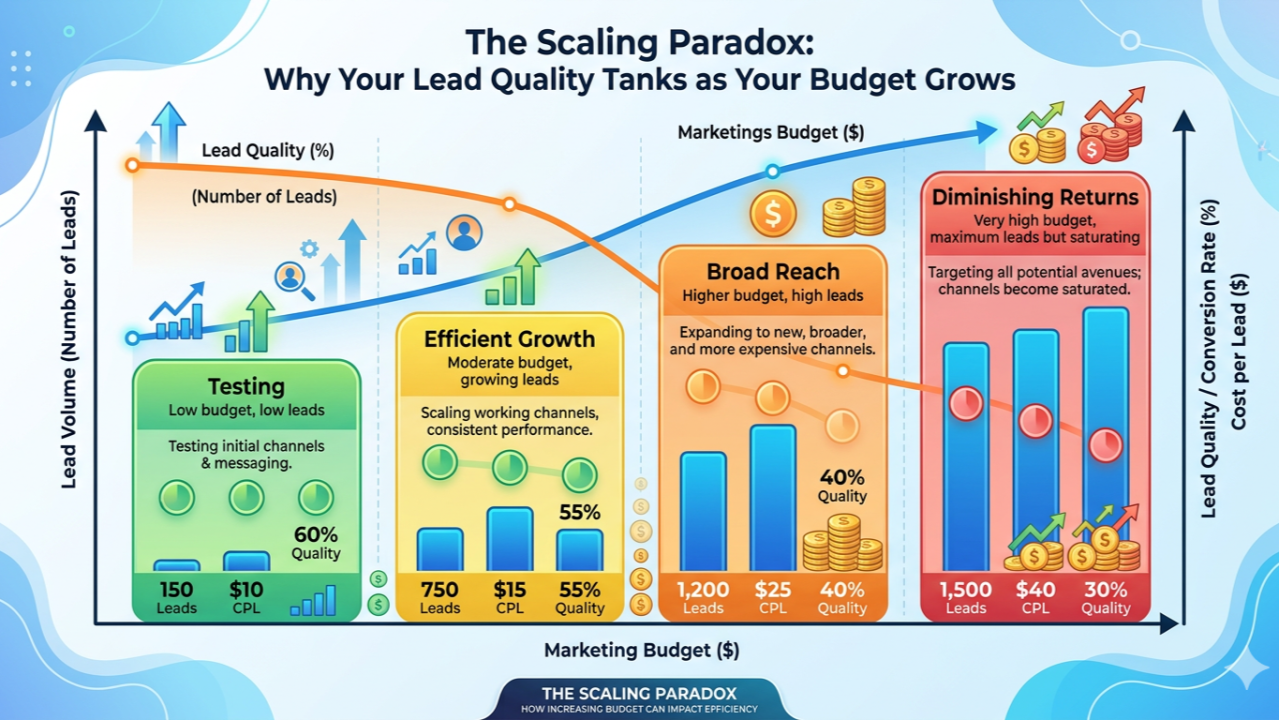
We’ve all been there. The campaign is performing well, the CPL (cost per lead) is stable, and the stakeholders are ready to pour gas on the fire. You double the budget, the lead volume spikes accordingly, and you’re ready for a victory lap.
Then, you get the Slack message from the Sales team:
“What happened to the leads? These are all students, job seekers, and people looking for freebies.”
It feels like a glitch in the matrix, but it’s actually a feature of how Google’s bidding system works. If you’re feeling the “Scaling Paradox,” here is exactly why it’s happening and how to fix your signal architecture.
The “Path of Least Resistance” Problem
Google’s Smart Bidding is an incredible piece of technology, but it’s also pathologically literal. It does exactly what you tell it to do.
If your conversion goal is set to “Form Fill,” Google’s algorithm views every single submission as a 10/10 success. It doesn’t know the difference between a CEO at a Fortune 500 company and a college student writing a thesis.
Here is the logic the algorithm follows when you scale:
- You give it more money to find more “conversions.”
- The algorithm looks for the “cheapest” and “easiest” conversions available in the auction.
- High-intent buyers are expensive and rare; “researchers” and “job seekers” are cheap and plentiful.
- To hit your volume targets, the system shifts your budget toward the easier, lower-quality traffic.
The result? You aren’t scaling your business; you’re just scaling your noise.
The Fix: Signal Architecture (Not More Keywords)
Most marketers try to fix this by tightening their keyword lists or adding “negative” keywords. While that helps, it’s a manual solution for an automated problem.
The real fix is signal architecture. You need to stop treating every lead as an equal and start feeding Google “value signals.”

How to Implement Better Signals
You don’t need to overcomplicate this. It’s about moving from quantity bidding to value bidding.
- Offline Conversion Tracking (OCT): Use tools like Zapier, HubSpot, or Salesforce integrations to “fire” a conversion back to Google Ads when a lead moves from “New” to “Qualified” in your CRM.
- Conversion Value Rules: Assign different monetary values to different stages. Even if you don’t have an exact dollar amount, tell Google a “sales qualified lead” is worth $100 and a “Form Fill” is worth $1. This forces the algorithm to prioritize the $100 action.
- Enhanced Conversions: Ensure you are capturing hashed first-party data (email, phone) to help Google match your CRM data back to the original ad click.
The Bottom Line
When you scale, the “easiest” conversions are always the lowest quality. If you want to grow without breaking your sales team’s spirit, you have to stop optimizing for clicks and start optimizing for revenue.
Stop looking for “better ads.” Start building a better signal.
Collaboratively Administrate Empowered Markets Via Plug-And-Play Networks.