
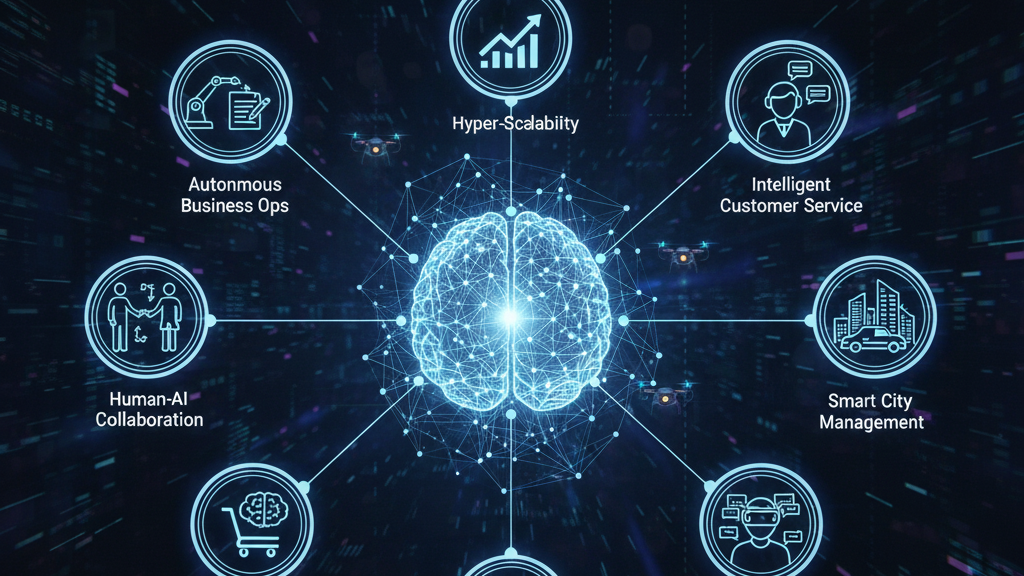
Artificial Intelligence agents have progressed far beyond simple, rule-driven assistants. Today’s AI agents exhibit increasing autonomy, advanced reasoning, and deep integration with modern machine learning, transforming industries by driving efficiency and innovation. Here are the key trends defining the future of AI agent development:
1. Autonomous Agent Architectures
AI agents are evolving into fully autonomous entities capable of managing complex workflows without continuous human intervention. Architectures such as React (Reasoning and Acting) and AutoGPT enable agents to understand high-level goals, divide them into manageable subtasks, prioritize actions, and self-correct errors as they operate. This autonomy allows AI agents to handle sophisticated scenarios in customer service, automation, and other domains, reducing the need for manual oversight and increasing operational speed.
2. Multi-Agent Collaboration Systems
Rather than a single AI handling everything, future systems feature multiple specialized agents working together as teams. Each agent brings expertise in specific tasks like planning, coding, or validation. These agents communicate and coordinate through shared protocols or memory spaces, mimicking human team collaboration. This multi-agent approach enables scalable problem-solving, allowing AI systems to tackle intricate challenges more effectively than isolated agents could alone.
3. Integration with Large Language Models and Foundation Models
Incorporating Large Language Models (LLMs) such as GPT-4, Claude, and other foundation models drastically expands AI agents’ capacities. These models empower agents to engage in nuanced, context-aware conversations, generate detailed summaries, write code snippets, and create original content. This cognitive layer enriches agents’ abilities to understand natural language deeply, making them far more useful in real-world applications spanning customer engagement, content creation, and decision support.
4. Real-Time Reasoning and Dynamic Planning
AI agents are moving beyond static, scripted responses to adopt true reasoning and planning abilities in real time. They analyze current situations, evaluate multiple options, and choose actions based on logic, historical data, and specific goals. This shift toward dynamic decision-making improves adaptability in rapidly changing environments such as financial trading, healthcare diagnostics, or logistics management, where timely and accurate responses are crucial.
5. Enhanced Tool Usage and API Integration
Next-generation AI agents are becoming digital operators capable of autonomously interacting with databases, software applications, and web services through API calls. They can retrieve information, execute code, send communications, and perform transactions across platforms without manual input. This ability transforms agents from passive assistants into active digital employees that seamlessly integrate within business workflows to execute tasks end-to-end.
6. Personalized and Context-Aware Experiences
Personalization is a critical feature of future AI agents. By analyzing user data — including preferences, interaction history, and behavioral insights — agents tailor their interactions and responses to individual needs and contexts. This is particularly valuable in sectors like e-commerce, education, and healthcare, where customized experiences improve user satisfaction, engagement, and outcomes while fostering long-term loyalty.
7. Emotionally Intelligent AI Agents
Emerging AI technologies are enabling agents to detect and respond to human emotions through voice tone analysis, facial expression recognition, or text sentiment detection. Emotionally intelligent agents adjust their responses to be more empathetic and supportive, enhancing user experience in sensitive contexts like therapy, customer support, and personalized learning. This emotional awareness brings AI interactions closer to genuine human connection.
8. Edge AI and On-Device Intelligence
Privacy concerns, low-latency requirements, and offline accessibility are driving AI development toward edge computing. AI agents embedded in smartphones, IoT devices, and wearables can perform tasks locally without relying extensively on cloud infrastructure. This decentralization supports real-time applications, such as home automation, autonomous vehicles, and health monitoring, by reducing response times and enhancing data security.
9. Focus on AI Safety and Ethical Alignment
As AI agents gain autonomy and influence, ensuring their alignment with human values and ethical standards is paramount. The industry is prioritizing safety frameworks, interpretability, and fail-safe measures to prevent unintended behaviors. Organizations like OpenAI and Anthropic are pioneering research into scalable oversight and mechanisms to keep AI actions transparent, controllable, and aligned with societal goals, safeguarding trustworthiness and ethical integrity.
10. Domain-Specific Agent Frameworks
AI agent development is becoming increasingly specialized to meet the unique needs of different industries. Custom frameworks tailored for domains such as legal services, finance, customer support, and cybersecurity incorporate domain knowledge, regulatory compliance, and workflow requirements. These specialized agents deliver higher accuracy, relevance, and reliability, making them indispensable tools for professional environments requiring nuanced expertise.
The evolution of AI agents into intelligent, autonomous digital workers heralds a transformative era. As these trends converge, businesses and developers gain unprecedented opportunities to leverage AI for enhanced productivity, deeper insights, and innovative problem-solving. The future promises AI agents that not only assist but also collaborate, innovate, and empathize — fundamentally reshaping how we work and interact with technology
Although China Has A Much Shorter History Of National Sustainability Policy And International Cooperation Compared With More Developed Economies, Especially In The Private Sector,